

Imaginal Journal
Imagination is Medicine
The Unseen Pain: Reframing Suicidal Ideation to Restore the Integrity of the Personal Spirit through the Collective Soul
I have struggled with suicidal ideation throughout my life. It is a symptom of living with Complex-PSTD and relates to how my nervous system and brain made sense of physically surviving life threatening or harmful experiences. Unprocessed events, locked away to prevent further damage, instead drawing more and more underminding power. Like the riskiest game of hide and seek, there is also a spiritual gamble. Much like the folk medicine concept of susto or soul loss where the personal spirit, in a state of terror, helplessness and overwhelm, detaches from the place of pain, the body.
The brain also fragments traumatic memories for self-preservation but can still access limbic recall through heightened emotional states and similar sense perceptions, ie, triggers that are displaced from the original cause, reading threat where there may not be one, and activating survival strategies in the amygdala- fight, flight, and freeze. This looks like a range of undue reactions that don’t necessarily match the current situation- ie, anxiety, preoccupation, hypervigilance, avoidance, rage, blame, shutdown, disassociation, people pleasing, loss of boundaries and agency, dread, despair, languishing.
Traumatic retention in the body can flood us in shame, guilt, and grief, causing self-imposed isolation, defensively guarding, and often times, rightfully distrustful of relational and environmental impact. As such, it's a disruption of the polyvagal nerve would otherwise support us to healthfully attach and engage socially. It can also impact the hormonal system by flooding the body in states of fear with hormones like cortisol and adrenaline, which over time disrupt the hypothalamic-pituitary-adrenal axis and can lead to chronic fatigue, autoimmune disorders and other inflammatory disease. The baseline of the sympathetic and parasympathetic, the gas pedal and breaks of nervous system, become highly sensitive to stimulus. This haywire physiological system can lead to high highs, low lows, and all sort of strategies to regain or loosen control, including addiction, perfectionism, driven by fear to seek or avoid pain and pleasure.
The sources of trauma are so varied from systemic, generational, inherited, identity-based, economic, racial, physical, medical, shock, emotional, relational, vicarious, natural disasters, violence, accidents, death, losses and so forth. While we all have the same biological mechanics, the way we experience suffering is particular, contextual and determined by the meaning ascribed. Whether the causes of trauma are known or hidden, the impact is palpable by its path of destruction -the confusion, self-criticism, dysregulation, dysfunctional relationships, abuses or misuse of power and undesired consequences.
What is needed is sustained help and engagement that over time can clear the distortions of this unconscious stress/trauma continuum. Instead of pathologizing and judging, the focus is to make it psychological- uncover the logic of the soul. The soul is collective. It is the deep ancestral well that holds the imagination and creative vital energies. The soul is never harmed, never destroyed. But our individual spirits can get lost, disembodied, and become porous making us susceptible to be dispossessed, haunted, or haunting.
So much of our human suffering and barriers to healing are caused by intergenerational influence, the inherited burdens and unpaid emotional debts of our kin. We can unknowingly become possessed by troubled spirits, especially by deceased family, who have not been reabsorbed by the ancestral lineage, repeating their vices, errors, and unresolved patterns. More disturbing, in states of disassociation, we can be taken over by malevolent entities that “protect” the host from their pain through destructive coping mechanisms. The personality can become completely highjacked, reenacting the drama of trauma by becoming perpetuators of harm, often similar to what happened to them. Unconsciously, the relief of the traumatic retention is released by running their pain through another body. In its worst expressions, this phenomenon is the contagious toxic spread of suffering, hell on earth.
But it does not have to be so. Reconnecting the individual spirit to the body of the earth, to the collective soul, to its rightful nature of a fluid sensual free body is key. As I have studied, clinically treated, and experienced this territory firsthand, by addressing the somatic body and the psychospiritual subtle body through engaging the soul with embodied imagination, a gateway to healing opens. We enter Great Mystery. Much like animist traditions across cultures and time, we call on the divine oversoul to clear our mind, body, and homes of all energies that are not of us and ask for protection, blessings, and the restoration of self trust.
We call on the support of well and loving deities, dream guides, the archetypal spirits of animals, trees, plants, place, elements, the mystical, the mythical, and trusted ancestors to be in communion in service of healing. We ask for blessings and protection to integrate our experiences, build relationships of devotion, offering and honoring, and reinforce our boundaries to disavow collusion with the shadow, especially aimed at our own demise. We commune with the collective soul and receive its intelligence as it speaks through stillness, meditation, mindful movement, contemplative conversations, invocation, ritual, music, dance, poetry, art and creative expression. Spontaneous memories, images, visions, color, words, and knowings emerge, the imaginal realm known to all children, sages, and mystics. Only though love in embodied presence can we heal. It is not a question of religion, it is a question of relating to the sacred and remembering that you, too, are sacred.
When we regard suicidality, understand the individual spirit has been harmed and exploited. The unseen pain is real. Do not fear the thought or the person’s pain. Let’s consider the logic of soul. Let's instead imagine the metaphorical death and initiate rebirth, returning the mind-body-soul alignment of presence. Let us work creatively with the images of death symbolically, ritualistically, and embody the support the soul needed. In this way, the psyche can experience a resilient feedback loop, complete the stress response cycle, reclaim the natural defenses or missing experiences, restoring integrity of action and ease accordingly, to make their life journey.
This is no different to the wisdom of shamanic processes held in healing setting or community- pushing the body to remember it is alive and directly accessing the divine- shaking, dancing. jumping, drumming, tapping, sweating, trembling, singing, screaming, fighting to restore their true nature, their agency, their truth, guiding the personal spirit to their temple body. Our suffering can then become a gateway to compassion, an intimate knowing and being with instead of rebuking the human experience. Instead of traumatized, we can become initiated ones, ones who have metabolized pain and gained strength, courage, and move between the seen and unseen realms with hard earned wisdom.
Because the truth is we are never destroyed- we are only ever recreated. The spirit needs beauty, needs truth, needs expression, needs love, needs play, needs liberty, needs belonging, needs nourishment, needs creation, needs joy, needs peace, needs us.
May all beings be safe from inner and outer harm
May all beings be free
May all beings experience peace and joy
May all being be filled with love and compassion
May all beings live their true nature
Atonement for Colonization
Beautiful inspiration for cultural repair for the harms of colonization
Dawn raids ceremony explained: Why Jacinda Ardern sat under a woven mat
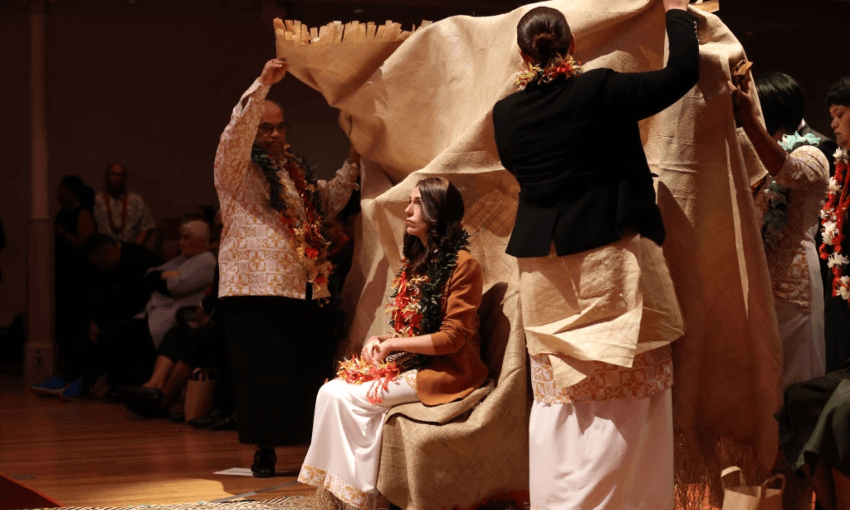
Jacinda Ardern with the ie tōga, part of the ifoga process, the Samoan tradition of asking for forgiveness. Photo by Fiona Goodall/Getty Images
August 2, 2021
Apulu Reece Autagavaia was among those who yesterday packed into Auckland Town Hall to witness the formal apology for the dawn raids. He explains the significance of the ifoga custom and what he hopes will follow this landmark event.
Last night, we witnessed the prime minister Jacinda Ardern perform the ifoga, a Sāmoan custom of asking for forgiveness.
Ifo means to bow down or lower oneself. Ifoga is when an offender covers themselves with a Sāmoan fine mat as an atonement for their or their kin’s wrongdoing. The covering occurs in front of the house of the victim. It is then up to the victim and their family or village whether to accept the ifoga. This can take some time, to allow the offender to pause and think about their actions while in the darkness, as well as time for the victim and their family to consider the future impacts of their decision, whether to accept or not. This is a public gesture before the entire village, as witnesses of this act of forgiveness.
In Sāmoan culture we talk about the “va” which roughly translates to relationships. When there’s an offence committed, that is called “soli le va” or trampling on the relationship.
While an offence maybe committed by an individual, it reflects on that individual’s family, extended family or village. Therefore, the ifoga is performed by the offender and his family, extended family/village. This is attempting to “teu le va” or mend the relationship.
The Sāmoan fine mat is referred to as many names. One such name is “tasi ae afe” which can mean one act can affect a thousand. This refers to the act of atonement by the offender, which can forgive many others, including the offender’s family, extended family, and village.
Jacinda Ardern remained under the fine mat for at least 10 minutes before it was lifted off again. (Photo: Justin Latif)
Another name for the Sāmoan fine mat is “pulou o le ola” which means being covered to gain life. This refers to the origin of the Sāmoan fine mat, where in one version, girls from the district of Amoa were weaving the very first fine mat. They were abducted and taken to Tonga where they ran into some controversy and were accused of hiding the King of Tonga’s brother. In pleading for their lives, the girls covered themselves in the fine mat they had woven.
Last night’s actions are unheard of by a world leader. Her compassion and humility was beautiful to watch, in particular when you consider Jacinda Ardern was not alive when the dawn raids occurred. This reflects that acts of cruelty have a generational impact. But, also, in Sāmoan culture, it’s never too late to “teu le va”.
And so, last night we heard from Jacinda Ardern attempt to “tausi le va” or nurture the relationship, broken by the dawn raids, with announcements of funding for scholarships and leadership assistance for Pacific nations and communities.
From left, Maungakiekie-Tamaki Local Board’s Nerissa Henry, Takanini MP Dr Anae Neru Leavasa, Otaki MP Terisa Ngobi, Palmerston North MP Tangi Utikere and Ōtara-Papatoetoe Local Board chair Apulu Reece Autagavaia. (Photo: Supplied)
It was deeply moving to see the minister of pacific peoples, Aupito Toesulusulu Tofae Su’a William Sio, in his full Sāmoan attire, namely his tatau (full body male tattoo). Aupito was representing not only the government of the day, but also those in the past: ministers, police and immigration officers directly responsible for the dawn raids. He stood there, staking his to’oto’o (staff) into the stage ground, which was an act of calling for his family and ancestral support – his father was sitting in the front row –and a beautiful act to watch. Aupito also waved and struck his fue (orator’s whisk) in the air, to call upon the ancestors for wisdom and guidance for this momentous occasion.
Aupito’s stance and physical presence was matched by his eloquent words. He called upon the nations to the north (Tokelau, Kiribati, Hawaii), to the east (Cook Islands, Tahiti, Rapa Nui), to the west (Tuvalu, Fiji, Futuna & Uvea), and then to the south (Tonga, Niue and Aotearoa). He called on the spirits to come and heal our communities, with a focus on strengthening the generations to come.
Aupito used the Sāmoan phrase, “E pala ma’a, ae lē pala upu” which means rocks and boulders will crumble, but words and promises last forever. This was accompanied with the Sāmoan custom of “ta’i le sua” which is the highest form of gifting in Sāmoan culture. The promises made by Jacinda Ardern were written on scrolls and gifted to the Pacific communities to show that words matter. Our cultures are oral cultures, and these words will be passed on from generation to generation. Aupito pulled out the important parts of this custom to show how genuine the government was in the gifting, while acknowledging racism still exists today.
These are unprecedented actions, which Pacific communities respect and show gratitude for.
The Auckland Town Hall was full for the dawn raid apology. Photo by Fiona Goodall/Getty Images
Speaking personally, I have so many emotions running through me that it will take a while to fully comprehend the impact of this apology. But I am humbled to have sat in that hall with my parents, and to witness this apology with them, knowing they lived through that era.
My mother has talked about how at the time of the dawn raids there was a chill that came over the Pacific community. No-one would go out in public. They stayed away from the shops. They wouldn’t socialise in public. There were hushed short conversations with passers-by, then straight home. There was real fear in people’s eyes as authorities were empowered to stop anyone who didn’t look white. During that time our family home in Grey Lynn was also raided, in that cold freezing dawn.
And so Sunday was the start of the re-warming of the cooled relationship which hung over our communities. I’m hopeful that under this government it could get hot enough for an amnesty for overstayers. The beautiful thing about “tausi le va” is that our relationships can grow and expand, so perhaps it could expand into a future amnesty? Let’s wait and see.
SOURCE: THE SPIN OFF